Every breast lift leaves scars, but their placement and appearance depend on your surgeon’s technique, your individual healing process, and how you care for your incisions during recovery. Below, we explain how our plastic surgeons match the right incision pattern to your anatomy and what to expect as your scars heal.
WARNING:
This feature contains nudity. Please click OK to confirm you are at least 18 years of age and are not offended by such material.


What Are My Breast Lift Incision Options?
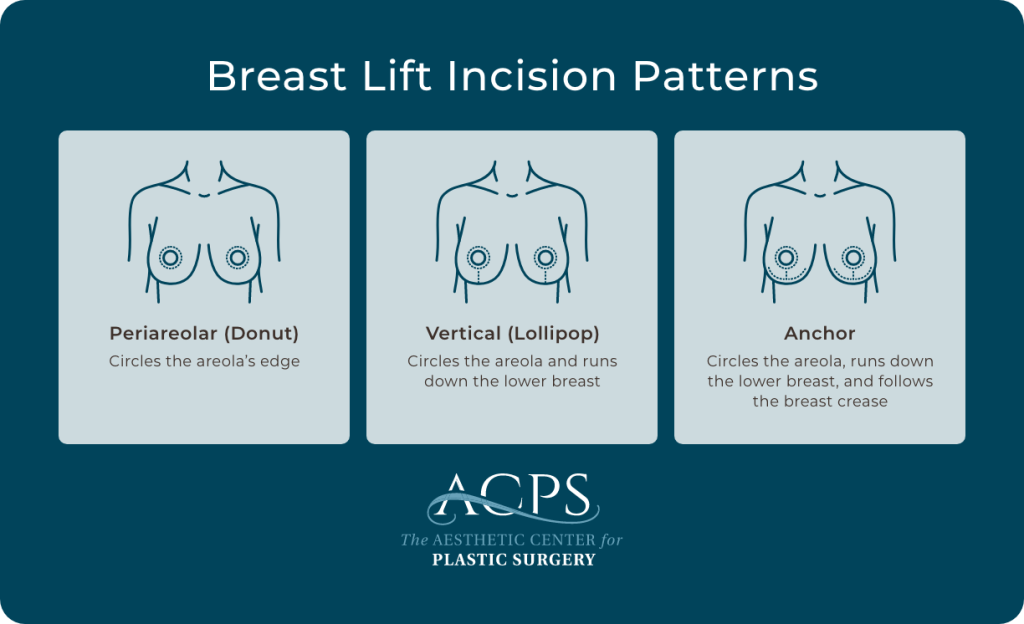
Our plastic surgeons typically use one of three breast lift incisions: periareolar, vertical, and anchor. Each one builds on the previous, offering greater skin removal and lifting capability.
The periareolar, or donut breast lift incision, circles the edge of the areola. Because it only removes a narrow ring of skin, it is best suited for patients with mild sagging. This incision pattern can also be used to reduce enlarged areolas.
The next level of incision is the vertical, or lollipop breast lift, which adds a line from the bottom of the areola to the breast crease. This second incision lets your surgeon tighten and reshape the lower breast to address moderate sagging.
The anchor pattern adds a third incision horizontally along the breast crease. Because it gives surgeons the most access to loose skin and tissue, it allows significant reshaping in patients with severe breast ptosis (sagging).
How Our Surgeons Choose Your Breast Lift Incision
Our surgeons base the decision on how much skin must be removed to raise the nipple and reshape the breast, which they assess during an in-person exam.
One of the first things we measure is where your nipple sits in relation to the breast crease. When it rests near the crease, a modest adjustment may be enough. When it falls well below the crease or points downward, more skin needs to be removed, requiring a more extensive incision pattern.
Skin quality matters too, since stretched skin lacks elasticity and may need a more extensive pattern to hold its new position. This laxity is especially common after significant weight loss, as the excess skin can’t “bounce” back to fit your body’s new contours.
Why a Smaller Incision Isn’t Always Better
A smaller incision removes less skin, so it can’t always deliver the lift your breasts need. When the pattern is too constrained for your anatomy, the breast may still sit low or look flat, and tension on the closure can stretch the areola or widen the scar.
These adverse effects are why we don’t choose an incision just to limit scarring. A longer incision that achieves the right lift can produce a more natural-looking result that holds its shape better, even with an extra line.
Are Breast Lift Scars Noticeable?
Breast lift scars are strategically placed along borders where the breast’s own shape and coloring help disguise them. The scar around the areola follows the line where darker skin meets lighter skin, so the color change helps it blend.
The vertical scar in a lollipop lift runs down the lower breast, an area that bras and most swimsuit tops cover, and the horizontal scar in an anchor pattern tucks into the crease beneath the breast, where the natural fold conceals it.
If you’re adding implants through a breast augmentation with lift, our surgeons can usually place them through the same incisions, so you can avoid a separate scar.
How Long Do Breast Lift Scars Stay Visible?
Breast lift scars typically stay visible for one to two years, fading gradually as they mature. Early on, they may look red or pink and slightly raised, even more so than they did right after surgery. This is a normal part of the healing process.
Expect your breast lift scars to gradually flatten and lighten over the following months, although their final appearance can vary. How your scars heal can vary depending on your skin type, genetics, and how well you care for your incisions after surgery.
You can see what healed scars look like at different stages of the healing process in our breast lift before and after photo gallery.
What To Expect as Your Breast Lift Scars Heal
| Timeframe | Appearance | Scar care |
| 1–2 weeks | Thin, closed lines with surrounding bruising and swelling | Follow your surgeon’s incision care instructions |
| 1–3 months | Pink to red with a raised, firm texture | Start silicone sheets or gel once your surgeon approves, and keep scars covered or out of direct sun exposure |
| 3–6 months | Deepest color for some patients, with texture starting to soften | Continue silicone, and apply sunscreen to any exposed scars |
| 6–12 months | Lighter and less raised | Continue silicone and sun protection |
| 12–24 months | Scars typically become flatter, softer, and less noticeable, although their final appearance varies. | Keep protecting scars from the sun, and mention any changes at follow-up visits |
How Can Breast Lift Scars Be Minimized?
Breast lift scars heal best when careful surgical technique is paired with good recovery habits. Our surgeons place incisions along natural lines and close them carefully to limit tension on the skin.
Your recovery habits matter just as much. Wearing your support bra as directed and holding off on strenuous activity keeps stress off the incisions while they heal, while being diligent about sun protection and scar care can support a better outcome.
We check your incisions at follow-up visits, so we can spot problems early and adjust your care if a scar is healing thicker or darker than expected.
Is a Breast Lift Worth the Scars?
Many patients find that the benefits of a breast lift outweigh the resulting scars. For most, the confidence and expanded wardrobe options that shapely, lifted breasts give them outweigh the scars. As the scars fade physically, they also tend to fade from patients’ minds, becoming unremarkable over time.
Which Breast Lift Incision Is Right for You?
There is no one “best” breast lift incision, only the one that best fits your anatomy and goals. Our experienced plastic surgeons can help you explore your breast enhancement options during your consultation. To get started, request a consultation or call The Aesthetic Center for Plastic Surgery at (713) 799-9999.


Leave a Reply