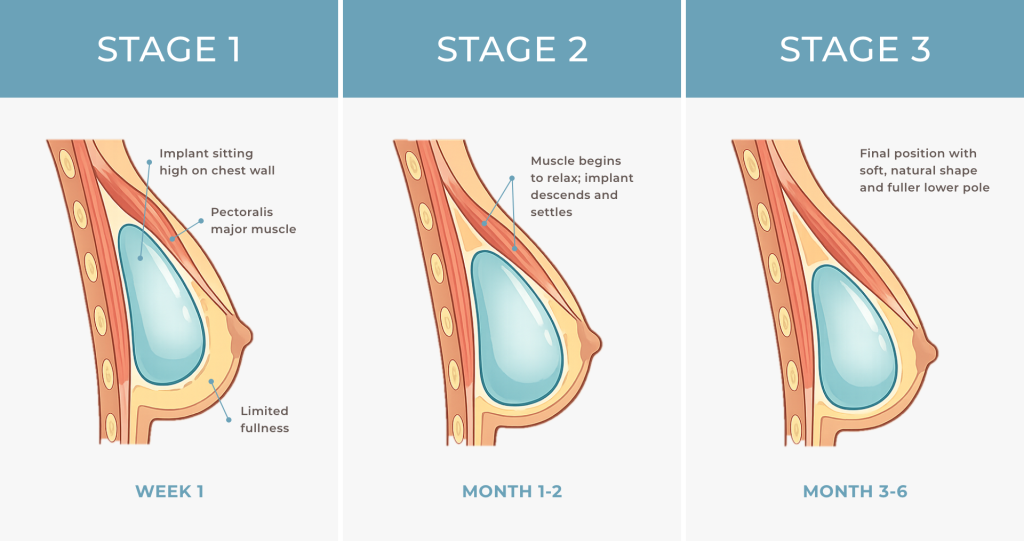
Most breast augmentation patients notice significant changes in the appearance and position of their implants within 6 to 12 weeks after surgery. However, the complete settling process typically takes 3 to 6 months, with subtle changes continuing for up to a year as the body fully heals. You may hear this process referred to as “drop and fluff.” While the term is popular among patients online, it isn’t an official medical term, and not every plastic surgeon uses it when discussing breast augmentation recovery.
Whether you call it implant settling or “drop and fluff,” the concept is the same. During the first few weeks after surgery, swelling is expected, and the implants often sit higher on the chest than they will long term. As swelling decreases and the surrounding tissues relax, the implants gradually settle into a more natural position, and the breasts become softer. Every patient heals differently, so your timeline may vary slightly from these general milestones.
What Does ‘Drop and Fluff’ Mean?
“Drop and fluff” is a patient-friendly term for two natural phases of healing after breast augmentation.
- Drop refers to the implants gradually moving into their final position as swelling decreases and the surrounding tissues relax.
- Fluff refers to the breasts becoming softer and fuller in appearance as the tissues loosen and the implants settle within the breast pocket.
Although patients frequently use the phrase online and in discussion forums, plastic surgeons typically refer to this process as implant settling, implant descent, or simply normal healing.
Why Do Breast Implants Sit High at First?
Immediately after breast augmentation, many patients are surprised to find that their implants sit high on the chest, feel firm, or appear flatter in the lower portion of the breasts. While this can be concerning, it’s a normal part of the healing process.
This happens for several reasons:
- Swelling temporarily elevates the breasts.
- The surgical pocket is still healing.
- The chest muscles may feel tight, particularly if the implants are placed beneath the pectoral muscle.
- The skin and breast tissues need time to stretch and adapt to the new implant volume.
These early changes are expected and are not a sign that something is wrong. As healing progresses, swelling decreases, the chest muscles relax, and the implants gradually move into a more natural position. Although the implants themselves do not change in size, the breasts often appear softer, fuller in the lower portion, and more balanced as they settle.
WARNING:
This feature contains nudity. Please click OK to confirm you are at least 18 years of age and are not offended by such material.


How Long Does It Take for Breast Implants to Settle?
Breast implants don’t suddenly settle overnight. Instead, they gradually move into their intended position as swelling decreases and the surrounding tissues heal. While every recovery is different, here’s what you can generally expect throughout the healing process:
The First Two Weeks
During the first two weeks, swelling is at its peak, and the implants often sit higher on the chest than they will long term. Your breasts may appear:
Your breasts may appear:
- Higher than expected
- Firmer than anticipated
- Slightly uneven
- Fuller in the upper portion of the breasts
This stage is completely normal. Your surgeon will advise you to avoid strenuous activity while your tissues begin healing.
Weeks 3 Through 6
As swelling continues to improve, many patients begin noticing visible changes. During this stage:
- The implants begin moving into a lower position.
- The lower portion of the breasts becomes fuller.
- Tightness gradually decreases.
- The breasts start feeling softer.
It’s also common for one breast to settle faster than the other. Mild differences in healing are expected and usually improve over time.
3 to 6 Months
By this point, most patients notice a more natural look and feel. The implants have typically settled into their intended position, the breasts feel softer, and the overall shape appears more balanced.
If your implants were placed beneath the chest muscle, the settling process may take a little longer because the muscle needs additional time to relax.
Patience is an important part of recovery. Giving your body time to heal allows your final results to develop naturally.
What Factors Affect How Quickly Implants Settle?
No two recoveries are exactly alike. Several factors influence how quickly breast implants settle after surgery.
Implant Placement
Implants placed beneath the chest muscle (submuscular or dual-plane placement) often take longer to settle because the pectoral muscle initially holds the implant higher on the chest. Implants placed above the muscle (subglandular placement) may settle somewhat more quickly because they aren’t influenced by pectoral muscle tension.
Your surgeon will recommend implant placement based on your anatomy, tissue characteristics, and aesthetic goals, not simply on recovery time.
Implant Size
Larger implants may place more tension on the surrounding tissues during healing, which can slightly extend the settling process. Smaller implants may settle differently depending on skin elasticity, tissue characteristics, and your body’s natural healing response.
Implant Type
Both silicone gel and saline implants require time to settle into their final position. While each implant type has different characteristics, the implant itself is only one of several factors that influence your recovery and final results.
Individual Anatomy
Your unique anatomy includes factors such as:
- Skin elasticity
- Existing breast tissue
- Chest wall anatomy
- Muscle tone
- Healing response
Each of these factors influences how quickly implants settle and how the final results develop.
If you’re still exploring breast augmentation, understanding how your anatomy influences your results can help you set realistic expectations before surgery. You can read about how your breast shape impacts breast augmentation and why our surgeons customize every surgical plan rather than using a one-size-fits-all approach.
What Will My Final Results Look Like?
Many patients are surprised by how much their breasts change during recovery.
Immediately after surgery, implants may look:
- Higher
- Rounder
- Firmer
- More swollen
As healing progresses, the breasts typically become:
- Softer
- More natural in contour
- Better balanced
- More proportionate to the body
If you’re concerned about results that don’t look natural, we recommend reading Will Breast Implants Look Natural?, which discusses the many factors that contribute to an attractive, personalized outcome.
Can You Speed Up Implant Settling?
Healing occurs on your body’s schedule, and there is no proven way to safely speed up the implant settling process. While you may come across tips online that promise faster results, following your surgeon’s postoperative instructions is the best way to support proper healing.
The best way to support recovery is by carefully following your surgeon’s postoperative instructions. These instructions may include:
- Wearing your surgical bra as directed
- Avoiding strenuous exercise until cleared
- Attending all follow-up appointments
- Sleeping in the recommended position
- Taking medications as prescribed
Some surgeons recommend implant massage or displacement exercises for certain patients and implant types, while others do not. Because postoperative recommendations vary, it’s important to follow the guidance provided by your surgical team rather than advice found online.
When Should You Contact Your Surgeon?
While uneven settling and temporary firmness are usually part of normal healing, you should contact your surgeon if you experience:
- Rapid swelling on one side
- Significant redness or warmth
- Fever
- Increasing pain rather than gradual improvement
- Drainage from the incision
- A breast that suddenly changes shape after initially healing well
Prompt communication allows your surgeon to determine whether your symptoms represent normal healing or require further evaluation.
Patience Is Key
One of the most important parts of breast augmentation recovery is understanding that your final results won’t be visible immediately after surgery. Implant settling is a gradual process that varies from one patient to the next, influenced by implant placement, implant size, your anatomy, and your body’s natural healing response.
You can discuss what you can realistically expect throughout recovery by using the online form to request a consultation with one of our breast surgery experts, or call us at (713) 799-9999.


Leave a Reply