
You may qualify for a mini tummy tuck if you have mild to moderate loose skin or stubborn fullness below the belly button, maintain a stable weight, and do not require significant muscle repair. Not all tummy tucks are the same, and many patients ask during their consultations whether a mini tummy tuck is the right option for them.
It’s a thoughtful question. A mini tummy tuck can deliver excellent results for the right patient. However, it’s not simply a smaller version of a full tummy tuck, nor is it appropriate for everyone. Understanding the differences between mini, full, and extended tummy tucks help clarify why candidacy matters and why a customized surgical plan is essential for achieving natural-looking results.
What Is a Mini Tummy Tuck?
A mini tummy tuck focuses on the lower abdomen only, specifically the area below the belly button. It is designed for patients with limited concerns, such as a small amount of loose skin or mild lower abdominal bulging.
Unlike a full tummy tuck, a mini tummy tuck does not involve repositioning the belly button and typically does not include repair of the upper abdominal muscles. Because the correction is more targeted, the procedure is less extensive and produces more modest, localized results.
Who Qualifies for a Mini Tummy Tuck?
A good candidate for a mini tummy tuck typically has:
- Mild skin laxity limited to the lower abdomen
- Minimal muscle separation, usually confined below the belly button
- A stable body weight near their long-term goal
- Good skin quality and elasticity
- Realistic expectations about what the procedure can and cannot accomplish
Many mini tummy tuck candidates are women who have had a single pregnancy and notice a small lower abdominal “pooch” that does not improve with diet or exercise. Others are patients who have lost a modest amount of weight and are left with mild skin looseness below the navel.
What these patients have in common is that their concerns are localized to the lower abdomen. If excess skin, muscle separation, or contour irregularities extend above the belly button, a mini tummy tuck alone is unlikely to provide a balanced or satisfying outcome.
When a Mini Tummy Tuck Is Not the Right Choice
A mini tummy tuck is often not appropriate if you have:
- Moderate to severe skin laxity above and below the belly button
- Noticeable muscle separation, known as diastasis recti, that extends upward
- Significant weight loss with excess skin extending toward the flanks
- Abdominal fullness driven primarily by internal fat rather than skin laxity
In these situations, choosing a mini tummy tuck may lead to suboptimal results. While the lower abdomen may appear improved, untreated laxity or bulging above the belly button can leave the midsection looking unbalanced. This is why a careful evaluation of your anatomy is essential before determining the most appropriate surgical approach.
WARNING:
This feature contains nudity. Please click OK to confirm you are at least 18 years of age and are not offended by such material.


Mini vs. Full vs. Extended Tummy Tucks: Key Differences
Understanding the distinctions between tummy tuck options helps clarify why candidacy is so important. Each approach is designed to address a specific anatomical pattern. Selecting the appropriate procedure ensures that tightening, smoothing, and contouring work together in a balanced and cohesive way.
| Consideration | Mini Tummy Tuck | Full Tummy Tuck | Extended Tummy Tuck |
|---|---|---|---|
| Anatomy Addressed | Lower abdomen only | Entire abdomen, above and below the belly button | Entire abdomen plus flanks or hips |
| Muscle Repair | Minimal or limited to the area below the belly button | Comprehensive repair of abdominal muscle separation | Full abdominal repair |
| Belly Button | Not repositioned | Repositioned to maintain a natural appearance | Repositioned |
| Ideal For | Mild lower abdominal skin laxity and subtle contour concerns | Pregnancy-related changes, moderate skin laxity, or muscle separation | Significant weight loss and excess skin extending beyond the front of the abdomen |
Incision Placement: What Patients Should Know
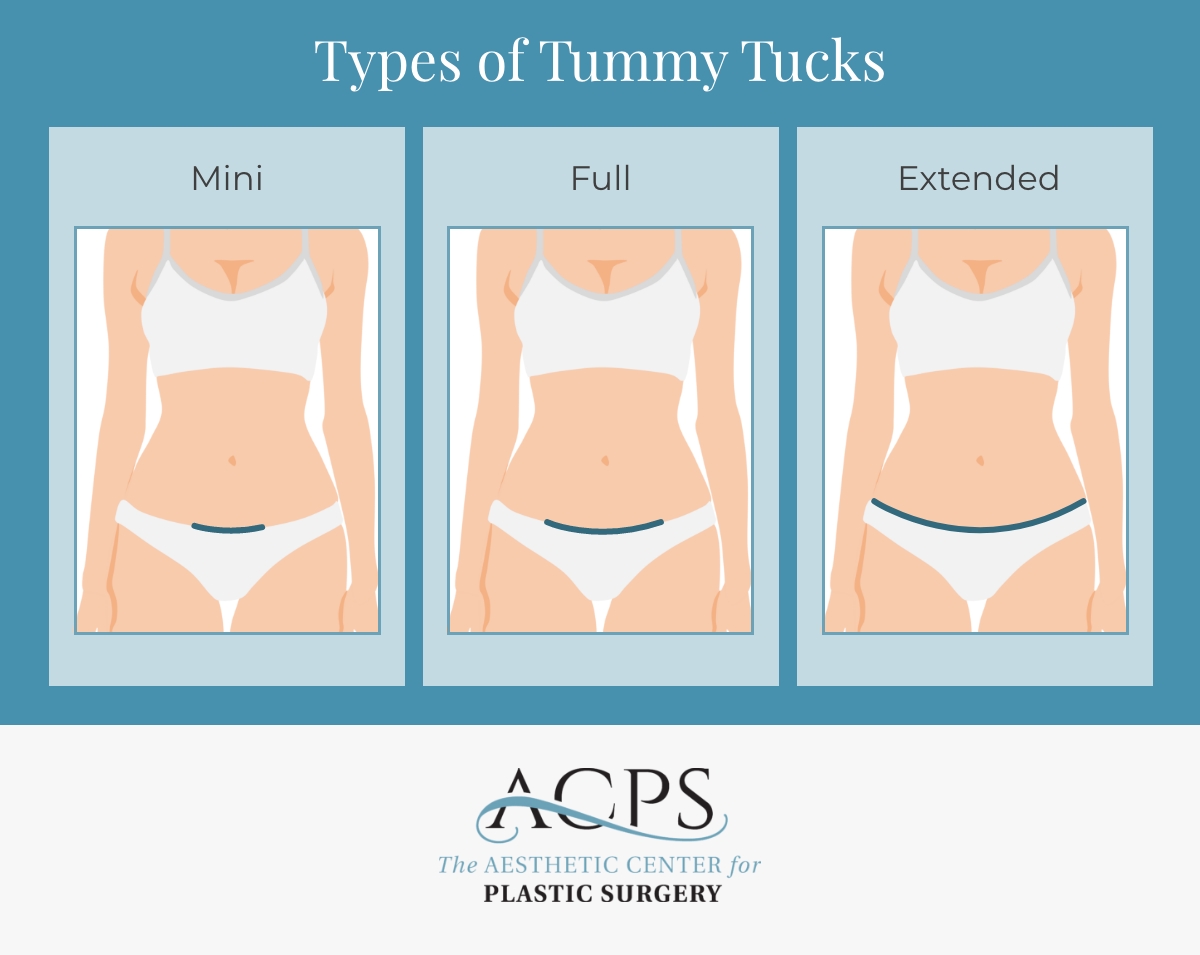
Incision location and length are among the key differences between tummy tuck types.
- Mini tummy tuck incision: A shorter horizontal incision placed low on the abdomen, often similar to or slightly longer than a C-section scar. It is typically positioned below the bikini line.
- Full tummy tuck incision: A longer horizontal incision extending from hip to hip, placed low enough to be concealed by underwear or swimwear. A second incision is made around the belly button.
- Extended tummy tuck incision: A longer horizontal incision that extends beyond the hips toward the lower back to address excess skin at the sides, along with an incision around the navel.
Although mini tummy tuck incisions are shorter, incision length alone should never determine the surgical approach. The priority is achieving the most balanced and satisfying result based on your anatomy.
The illustration below highlights the typical horizontal incision patterns associated with each type of tummy tuck.
Why Muscle Separation Matters
One of the most common reasons a patient may require a full tummy tuck rather than a mini is muscle separation. Diastasis recti can cause visible abdominal bulging, even in thin or otherwise fit individuals. While targeted exercise may improve core strength and very mild separation, moderate to severe diastasis recti typically cannot be fully corrected without surgical repair.
If muscle separation extends above the belly button, a mini tummy tuck will not address it. In these cases, correcting only the lower abdomen can leave persistent upper abdominal fullness, compromising overall balance and contour.
The Importance of a Customized Surgical Plan
No two bodies are identical, and no single tummy tuck technique is appropriate for everyone. At ACPS, our board-certified plastic surgeons evaluate skin quality, muscle integrity, fat distribution, and overall body contour before recommending a procedure. One of our body contouring specialists, Dr. Christopher Patronella, has been honored multiple times for developing the True Form Tummy Tuck® technique.
In some cases, surgeons combine liposuction with a mini or full tummy tuck to refine the waistline. In others, a full or extended tummy tuck alone provides the most natural-looking, proportional outcome. The most satisfying results come from matching the procedure to the patient’s anatomy, not the other way around.
Start With a Consultation
A mini tummy tuck can be an excellent option for carefully selected patients with mild lower abdominal concerns. If you would like to discuss your options with one of our surgeons, request a consultation using the online form or call us at (713) 799-9999 to schedule an appointment.




Leave a Reply